|
|
Calendars
of the Middle East
January 2000 Commentary by Rick Francona
Let's pick a date:
The Jewish (or Hebrew) Calendar The Hebrew calendar is the official calendar of the state of Israel and the Jewish faith. The number of the year number represents the number of years since creation, calculated by adding up the ages of people in the Bible. According to the Jewish calendar, creation began on October 7, 3760 BC in the Gregorian calendar. (Note that Israelis and persons of the Jewish faith do not generally use the terms AD and BC, since they do not recognize the religious meanings attached to the common Gregorian calendar. Instead they use CE, for Common Era, and BCE, for Before the Common Era.) The Hebrew calendar is what is referred to as a "lunisolar" calendar. In other words, the first day of each month is normally close to a new moon, but unlike strictly lunar calendars, a given month occurs at a given time in the solar year. This is accomplished by adding days and months to lengthen a strictly lunar calendar to coincide with a solar year (11 days longer). Years are 50 weeks plus three, four, or five days. The excess days are used to reconcile lunar and solar years. The first month of the Jewish calendar is the month of Nissan, in the spring, when Passover occurs. The Gregorian Calendar The Gregorian calendar is the standard calendar of most of the world today. It is a minor modification of the Julian calendar to better handle leap years. The Julian calendar practice of a leap year every four years did not address the error of about 18 hours per century. By the 16th Century, the calendar was 10 days off - making accurate calculations for Easter impossible. Pope Gregory XIII (for whom the calendar is named) took two steps to deal with this. First, he decreed that October 4, 1582 would be followed by October 15, 1582. Further, he decreed that three out of every four century years (those ending in 00) would not be leap years. So, while 1700, 1800, and 1900 were not leap years; the year 2000 will be. The calendar was instituted by a papal bull in early 1582. Although the Roman Catholic world adopted the new calculations, most Protestant states did not until several hundred years later. As international communications and commerce developed, the Gregorian calendar was eventually adopted as the common civil calendar throughout the world. The Islamic (Hijrah) Calendar The Islamic calendar is a strictly lunar calendar, and makes only minor efforts to track the solar cycle, so a given month can occur in any season. The year is 354 days long. As a result, the cycle of twelve lunar months regresses through the seasons over a period of about 33 years. The Islamic calendar begins on a date corresponding to Thursday, July 16, 622 AD, the date commemorating the migration of Muhammad and his followers from Al-Makkah (Mecca) to Al-Madinah (Medina). The years are referred to as 'Am Al-Hijrah, abbreviated AH. The basis of the Islamic calendar was laid down by Muhammad in the Qur'an (Sura IX, verse 36-37) and in his sermon at the farewell pilgrimage. The introduction of the Hijrah calendar replaced the lunisolar calendar that had been used in the Arab world, in which extra months were added occasionally to reconcile lunar and solar years. There are twelve months in the Islamic calendar. Since it is strictly a lunar calendar, there is no correlation to the Hebrew, Gregorian, or Persian calendars. The Persian (Jalali) Calendar The Persian, or Jalali,
calendar is official in Iran and in some surrounding nations, such as Afghanistan
and some Central Asian nations. The years of the Persian calendar begin
at the same time as the Islamic calendar (July 16, 622 AD), but since solar
years are longer than the Islamic calendar's lunar years, the year total
is lower, hence the current Persian year of 1378 while the Islamic year
is 1420. Like the Gregorian and Julian calendars, the Persian calendar
is strictly solar in nature, matches the four seasons, and makes no real
effort to reflect lunar cycles. The new year (Now Ruz) begins at
the spring equinox, Tehran time.
|
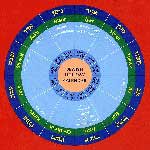 Much hoopla has been made of the Year 2000, including the ongoing debate
if in fact this is the beginning of the third millennium or the end of
the second. In the Middle East, with the confluence of three of the world's
major religions as well as different cultures, what day and year is it?
It depends on whom you ask.
Much hoopla has been made of the Year 2000, including the ongoing debate
if in fact this is the beginning of the third millennium or the end of
the second. In the Middle East, with the confluence of three of the world's
major religions as well as different cultures, what day and year is it?
It depends on whom you ask.