|
|
Saudi
Arabia's 'Abdullah - The Man Who Will Be King
June 2002 Commentary by Rick Francona
The Saudi ruling family is extremely secretive by nature. Many observers suspect that Fahd's health is much worse than portrayed in Saudi media. The king has been ill for several years. When he suffered a stroke in 1995, the situation was serious enough for 'Abdullah to be appointed regent for several months. When King Fahd does die, the senior members of the Saudi royal family - the sons of the kingdom's founder 'Abd Al-'Aziz - will meet to choose his successor. Although 'Abdullah is the overwhelming favorite, there have been noises of a challenge, that being Prince Sultan bin 'Abd Al-'Aziz, the minister of defense and aviation. Like King Fahd and five other members of the senior royal family, Sultan is one of the "Sudayri Seven." King Fahd is the eldest brother of the Sudayri Seven. These are seven sons of King 'Abd Al-'Aziz from the same mother, Hasa bint Ahmad Al-Sudayri. Many have assumed powerful positions in the government, based on the full fraternal relationship. In addition to King Fahd and defense chief Sultan, 'Abd Al-Rahman is deputy minister of defense and aviation, Nayif is the minister of the interior, and Salman is the governor of Riyadh province. Turki, 'Abd Al-Rahman and Ahmad also hold positions in the government. These seven brothers - and now their sons - are the power behind the kingdom's future. 'Abdullah bin 'Abd Al-'Aziz and the United States Crown Prince and First Deputy Prime Minister 'Abdullah bin 'Abd Al-'Aziz Al Sa'ud, is half-brother to the king and heir to the throne since 1982, served as regent from 1 January to 22 February 1996. 'Abdullah, 78, has been the commander of the Saudi National Guard since 1963. The Saudi Arabian National Guard is an independent military force made up of descendants of the original armed supporters of King 'Abd Al-'Aziz, and is meant to act as a counter to any possible anti-government activities by the armed forces. In times of national emergency, it is attached to the army, as they were in the Gulf War against the Iraqis in 1991. Assuming that 'Abdullah is named to succeed King Fahd, the close relationship between Washington and Riyadh may cool. Fahd is the latest in a line of pro-Western Saudi kings who have used the country's immense oil reserves - the largest in the world, over 250 billion barrels - to maintain stable oil prices. These stable oil prices, and access to the oil, is a key U.S. national interest. For this price stability, Saudi Arabia has been assured that the military power of the United States is available to protect the kingdom. 'Abdullah, however, is much less enamored of the United States than his predecessors. He may be less inclined to purchase American or western weapons, and may take a harder line when Saudi military facilities are needed for operations against Iraq. Fahd's failing health and 'Abdullah's hands-on running of the kingdom may have been the reason that during Operation Desert Fox in December 1998, Saudi Arabia refused to allow bombing missions to be conducted from its airfields. As he prepares to assume the throne, 'Abdullah has made numerous trips around the world and throughout the region to prepare Saudi Arabia's key partners for the event. As events bring Washington
and Baghdad to a convergence later this year, it will be interesting to
watch which way 'Abdullah leads Saudi Arabia.
|
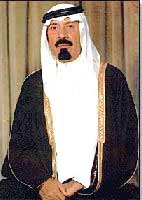 As
Saudi Arabia's long-ailing King Fahd recovers from yet another major medical
problem, it is apparent that much of the day-to-day responsibility for
running the affairs of the oil-rich Kingdom is in the hands of the king's
half-brother and almost certain successor, Crown Prince 'Abdullah bin 'Abd
Al-'Aziz. 'Abdullah, regarded almost as an outsider by many of the senior
royal family, will probably not be as close to the United States as his
predecessors, possibly causing difficulties for the United States in defending
its interest in the Persian Gulf.
As
Saudi Arabia's long-ailing King Fahd recovers from yet another major medical
problem, it is apparent that much of the day-to-day responsibility for
running the affairs of the oil-rich Kingdom is in the hands of the king's
half-brother and almost certain successor, Crown Prince 'Abdullah bin 'Abd
Al-'Aziz. 'Abdullah, regarded almost as an outsider by many of the senior
royal family, will probably not be as close to the United States as his
predecessors, possibly causing difficulties for the United States in defending
its interest in the Persian Gulf.